
Bachelor of Engineering Technology (Cyber Security) Details
The Bachelor of Engineering Technology (Cyber Security) is a four-year undergraduate engineering technology program designed to prepare students for careers in safeguarding digital infrastructure, networks, and information systems against evolving cyber threats. The program blends core computer science and engineering principles with specialized training in cybersecurity technologies, practices, and policies.
Students gain in-depth knowledge of areas such as:
-
Computer Networks and Operating Systems
-
Cryptography and Data Protection
-
Ethical Hacking and Penetration Testing
-
Cyber Forensics and Incident Response
-
Cloud and Network Security
-
Artificial Intelligence and Security Analytics
-
Cyber Laws, Policies, and Risk Management
The course emphasizes both theoretical foundations and practical, hands-on skills through laboratory work, simulated cyber-attack scenarios, internships, and industry-driven projects.
Graduates will be equipped to take on roles such as Cybersecurity Analyst, Network Security Engineer, Security Consultant, Ethical Hacker, Cyber Forensics Expert, and Security Architect, and will be prepared for global certifications (like CEH, CISSP, CompTIA Security+, etc.) to enhance employability.
The program also nurtures critical thinking, problem-solving, and ethical responsibility, enabling students to protect organizations and society from ever-increasing cyber risks.
Program Educational Objectives (PEOs):
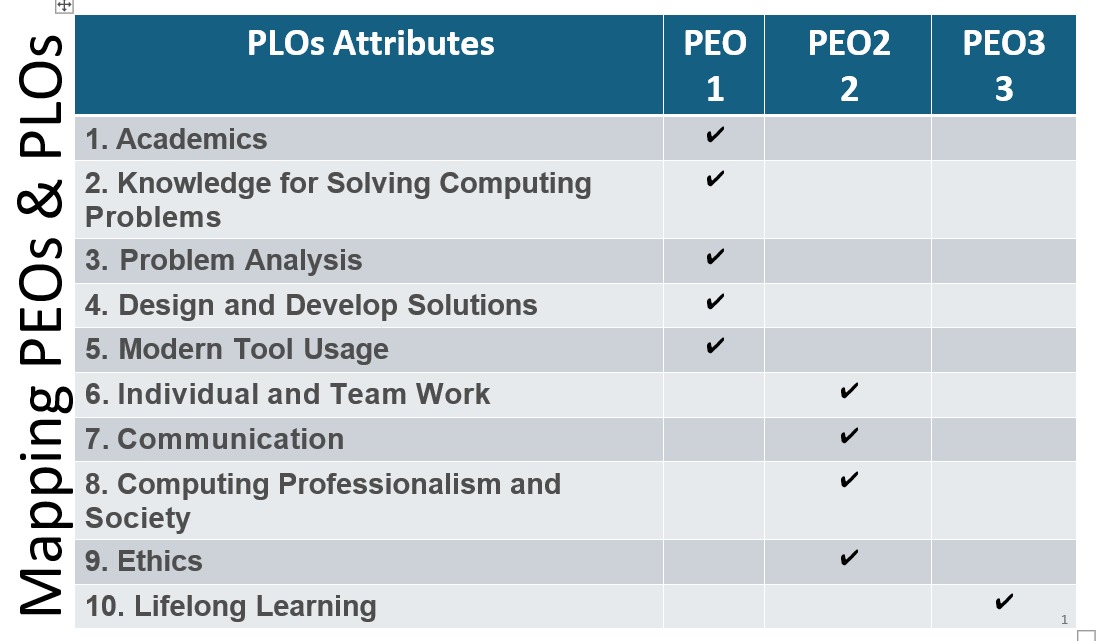
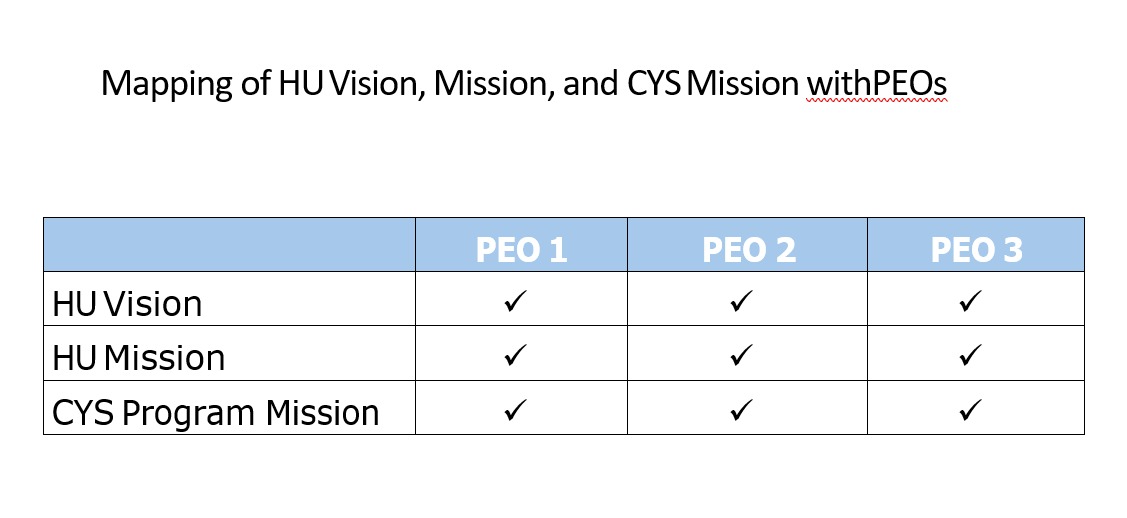
- PEO1: Graduates dutifully work in a variety of cyber security and allied disciplines.
- PEO2: Graduates utilizing their knowledge and abilities to solve cyber security related technological & computational problems in real world.
- PEO3: Graduates demonstrating sustainable learning and adapting to evolving fields through continued professional development and self-study.
Program Learning Outcomes (PLOs):
- Academics: To prepare the graduates as Computing & Engineering Technologist by Profession.
- Knowledge for Solving Computing Problems: Applying knowledge of computing fundamentals and its specialization, mathematics, science, and domain knowledge appropriate for the computing specialization to the abstraction and conceptualization of computing models from defined problems and requirements.
- Problem Analysis: Identify, formulate, research literature, and solve complex computing problems reaching substantiated conclusions using fundamental principles of mathematics, computing sciences, and relevant domain disciplines.
- Design and Develop Solutions: Design and evaluate solutions for complex computing problems, and design & evaluate systems, components, or processes that meet specified needs with appropriate consideration for public health and safety, cultural, societal, and environmental considerations.
- Modern Tool Usage: Create, select, adapt and apply appropriate techniques, resources, and modern computing tools to complex computing activities, with an understanding of the limitations.
- Individual and Team Work: Function effectively as an individual and as a member or leader in diverse teams and in multi-disciplinary settings.
- Communication: Communicate effectively with the computing community and with society at large about complex computing activities by being able to comprehend and write effective reports, design documentation, make effective presentations, and give and understand clear instructions.
- Computing Professionalism and Society: Understand and assess societal, health, safety, legal, and cultural issues within local and global contexts, and the consequential responsibilities relevant to professional computing practice.
- Professional Ethics: Understand and commit to professional ethics, responsibilities, and norms of professional computing practice.
- Lifelong Learning: Recognize the need, and have the ability, to engage in independent learning for continual development as a computing professional.
Courses
| Course Code | Course Title | Credit Hours | Pre requisite | Semester | Year |
|---|---|---|---|---|---|
| CS100 | Introduction to Computer | 3 | None | I Semester | 1 Year |
| MTH101 | Calculus | 3 | None | I Semester | 1 Year |
| IRS100 | Islamic Studies | 3 | None | I Semester | 1 Year |
| ECON100 | Basic Economics | 3 | None | I Semester | 1 Year |
| CY111 | Programming Fundamentals | 3 | None | I Semester | 1 Year |
| CYS123 | Digital Electronics | 3 | None | I Semester | 1 Year |
| ENG100 | Functional English | 3 | None | II Semester | 1 Year |
| PS100 | Pakistan Studies 4 | 3 | None | II Semester | 1 Year |
| TAH100 | Tourism and Hospitality | 3 | None | II Semester | 1 Year |
| SOC102 | Civics and Community Engagement | 3 | None | II Semester | 1 Year |
| CYS121 | Object Oriented Programming | 3 | None | II Semester | 1 Year |
| CYS122 | Linear Algebra | 3 | None | II Semester | 1 Year |
| Course Code | Course Title | Credit Hours | Pre requisite | Semester | Year |
|---|---|---|---|---|---|
| ENG102 | Expository Writing | 3 | None | III | 2 Year |
| STAT100 | Basics Statistics | 3 | None | III | 2 Year |
| AI100 | Introduction to AI | 3 | None | III | 2 Year |
| CYS231 | Data Structure and Algorithms | 3 | None | III | 2 Year |
| CYS232 | Computer Networks | 3 | None | III | 2 Year |
| CYS234 | Database Systems | 3 | None | III | 2 Year |
| CYS246 | Cyber Security Principles and Concepts | 3 | None | IV | 2 Year |
| IRS120 | Serat ul Nabi | 3 | None | IV | 2 Year |
| MGT171 | Introduction to Entrepreneurship | 3 | None | IV | 2 Year |
| PS103 | Ideology and Constitution of Pakistan | 3 | None | IV | 2 Year |
| CYS241 | Operating Systems | 3 | None | IV | 2 Year |
| CYS243 | Computer Architecture and Organization | 3 | None | IV | 2 Year |
| Course Code | Course Title | Credit Hours | Pre requisite | Semester | Year |
|---|---|---|---|---|---|
| CYS233 | Software Engineering | 3 | None | V | 3 Year |
| CYS242 | Information Security | 3 | None | V | 3 Year |
| CYS224 | Web Development Technologies | 3 | None | V | 3 Year |
| CYS245 | Artificial Intelligence | 3 | None | V | 3 Year |
| CYS356 | Cryptography | 3 | None | V | 3 Year |
| CYS364 | Wireless Networks Security | 3 | None | V | 3 Year |
| CYS474 | Software Defined Networking | 3 | None | VI | 3 Year |
| CYS471 | Embedded Systems Security | 3 | None | VI | 3 Year |
| CYS362 | Digital Forensics and Laws | 3 | None | VI | 3 Year |
| CYS244 | System and Network Administration | 3 | None | VI | 3 Year |
| PR100 | Project – I | 3 | None | VI | 3 Year |
| Course Code | Course Title | Credit Hours | Pre requisite | Semester | Year |
|---|---|---|---|---|---|
| CYS477 | Cloud Computing and IoT | 3 | None | VII | 4 Year |
| CYS482 | Security in Ad Hoc Sensor Networks | 3 | None | VII | 4 Year |
| CYS366 | Machine Learning | 3 | None | VII | 4 Year |
| CYS476 | Smart Surveillance Systems | 3 | None | VII | 4 Year |
| CYS | Project – II | 3 | None | VII | 4 Year |
| CYS500 | Supervised Industrial Training | 3 | None | VIII | 4 Year |
| Course Code | Course Title | Credit Hours | Pre requisite | Semester | Year |
|---|---|---|---|---|---|
| No Record Added Yet | |||||
